Open a Bible to the first page and read slowly. God makes the animals, then makes human beings, male and female, in a single stroke. Turn one page. Suddenly the man comes first, alone, then the animals are made to keep him company, and only after that does the woman arrive out of his side. Two orders of events, three verses apart. If you have ever felt your stomach drop at that, you are not faithless. You just noticed something real.
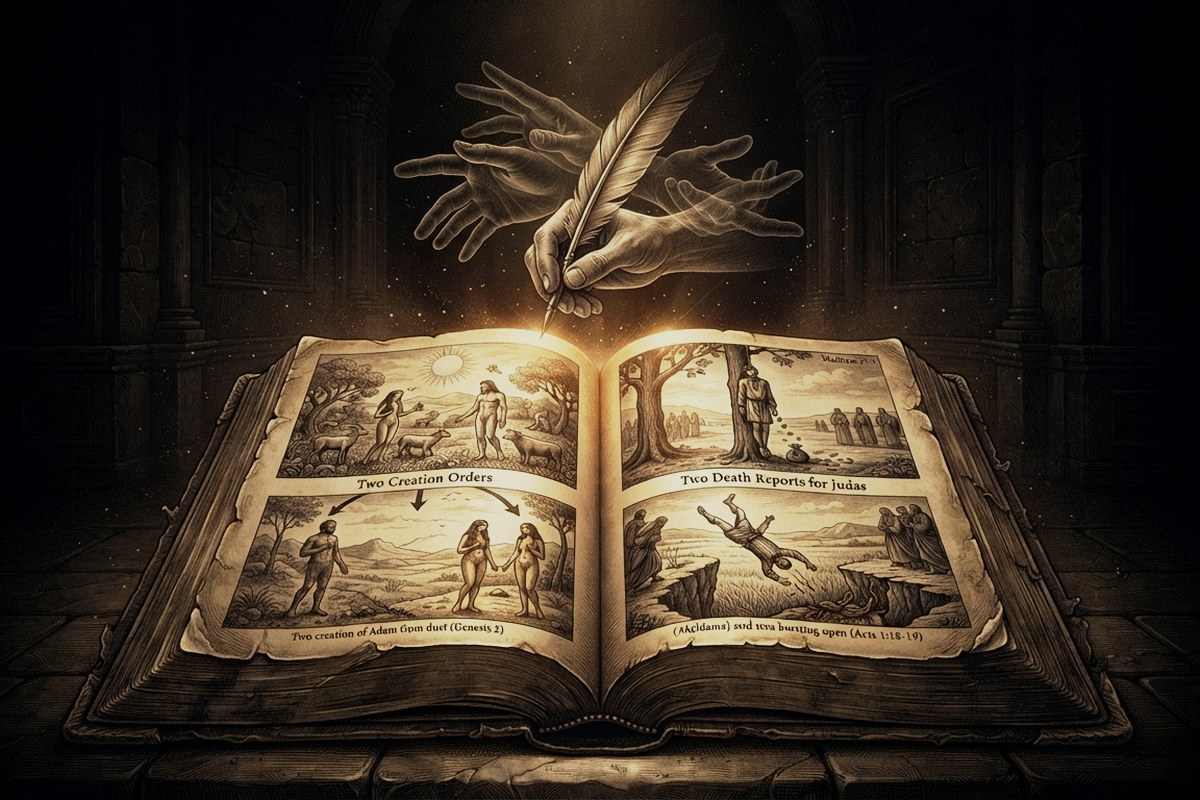
People have spent centuries smoothing this over. Some say chapter one is a summary and chapter two a close-up. Maybe. But there is another way that does not require the book to be a newspaper. What if scripture was never meant to record what happened out there, but to map what happens in here? Then the seams are not cracks in the foundation. They are fingerprints.
Two creation stories, two halves of one mind
Chapter one moves in wide, sweeping rhythms: light, sky, sea, land, and finally a human being made in the image of God, "male and female he created them" (Genesis 1:27). Chapter two slows down and gets personal. God forms the man from dust, breathes into his nostrils, then builds the woman from his rib while he sleeps (Genesis 2:7, 21-22).
Read symbolically, these are not competing timelines but two portraits of one inner life. Chapter one is the wide view: you are made in the image of something whole, and that wholeness is not divided by role or gender. Chapter two is the close view, the way you actually experience yourself: formed from the ground, dependent on breath, lonely until something is taken out of you and handed back.
In the second story the animals are made to cure the man's loneliness, and they do not. That is not biology. That is every distraction you have ever used to fill a hole inside yourself. The woman is not a rib turned into a person. She is the part of you that you did not know you had, and it came from your own side.
Seven pairs or two, and why nobody fixed it
In Genesis 6:19 God tells Noah to bring two of every kind onto the ark. In Genesis 7:2, a few verses later, it becomes seven pairs of clean animals and one pair of unclean. Two numbers, same boat.
Critics wave this like a flag. Believers blush and change the subject. But watch what the discrepancy tells you: two storytellers remembered it differently, and nobody thought it worth erasing. Ancient editors changed text whenever they wanted. They left these seams visible. What they kept was not a fact sheet but the living voice of people trying to say something about rescue.
Two deaths of Judas, one betrayal inside you
Matthew says Judas hanged himself (Matthew 27:5). Acts says he fell headlong and burst open (Acts 1:18). Side by side the contradiction is plain. Read as symbols, both say the same thing about a man who sold what he loved for silver.
The hanging is the death of a self that cannot bear to look at itself. The falling is the collapse of something already broken open. Neither is a courtroom transcript. Both say what happens to the part of you that betrays its own knowing: it does not get a gentle ending, and the ending is grotesque because the betrayal is grotesque.
Matthew and Acts were written for different communities that never agreed on details. If four people describe a dream and every object matches, you assume they compared notes. Scripture did not compare notes. It kept the mess.
Four empty tombs, four sets of witnesses
Read the resurrection accounts back to back and the witnesses change. Matthew has Mary Magdalene and the other Mary. Mark adds Salome. Luke adds Joanna. John gives you Mary Magdalene alone. No two lists match.
For a historian that is a problem. For someone reading the Bible as a map of the mind, it is the point. The resurrection is not reported as an event a camera could catch, but as a thing that happens inside a person, and inside events look different depending on who is looking. One meets the risen Christ in a garden and mistakes him for a gardener. One knows him only when bread is broken. One needs to touch the wounds.
That is not sloppy editing. It is an honest description of the old self dying and something stands up that you thought was gone. The cross is the body: where your old way of living is put to death, because it cannot be carried further. The resurrection is what comes after, through a different door for each person. Jesus is not a man in the sky who came back from the dead. Jesus is imagination, the image of God in you, and imagination is the one faculty that can be buried and come back.
So no, the Bible does not agree with itself, and it never claimed to. It is a library, not a legal brief. It disagrees because many hands wrote it over many centuries, describing something that does not sit still. Pointing that out is not an attack on faith. It is reading it the way it was meant to be read: as a mirror held up to the only place any of this happens. Inside you.
Want to decode passages like this without getting lost?
Get the free quick-start guide: 10 Core Bible Symbols Decoded in Plain English — plus a 2-minute way to use any symbol on a hard day.
Instant PDF, plus a short weekly note. Unsubscribe any time.✦ This is only the surface ✦
Every word of the Bible carries a hidden meaning — and there is far deeper teaching in the Parallels, the full study library.
Enter the Member Library Join on Telegram