Say the word "sin" out loud and watch what happens in the room. People sit a little lower. Somebody makes a joke. Almost nobody asks what the word actually means, because the meaning feels obvious — a rule got broken, a line got crossed, somebody is owed an apology. But the word Jesus and Paul used does not come from a courtroom at all. It comes from a practice field, and once you see the picture, the whole weight of the thing shifts.
The Original Word Means "Missed the Mark"
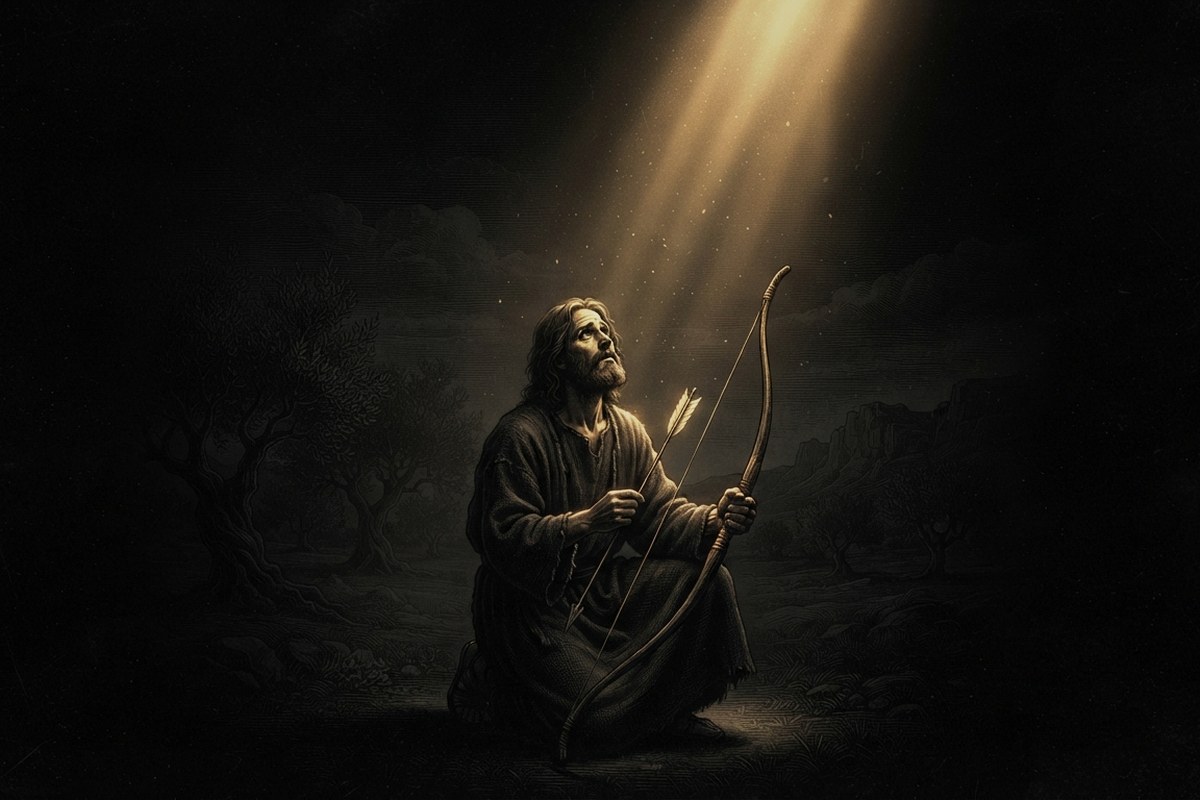
The Greek word behind almost every "sin" in the New Testament is hamartia. It is an archery term. It means to shoot and come up short — the arrow leaves the bow, travels, and lands wide of where it was aimed. There is no judge in that image, no gavel, no ledger. There is a target, a bow, and a shot that did not get there.
Paul uses it that way in Romans: "All have sinned and fall short of the glory of God" (Romans 3:23). Read it as a description rather than a verdict and it stops being an accusation and becomes an observation. Everyone is aiming at something and everyone is landing short of it. That is not a crime report. It is a report on aim.
So what is the target? In this reading, the glory of God is not a throne room in the sky. It is the life you were actually built for — the version of you that is whole, unafraid, and generous without keeping score. Sin, then, is not primarily something you did to God. It is you imagining against your own good. You aim at safety and hit suspicion. You aim at being loved and hit control. The arrow lands in your own foot.
Sin Is a State, Not a Debt
If sin were a debt, the sensible response would be payment — somebody has to cover the balance, and until they do, you sit in the holding cell. That is the picture most people carry around, and it is why the cross gets explained as a transaction. But a missed shot is not a debt. You cannot pay an arrow back. You can only nock another one and correct your aim.
Genesis gives the better image. God speaks to Cain before the worst of it and says, "Sin is crouching at your door; it desires to have you, but you must rule over it" (Genesis 4:7). Crouching. At the door. Not filed in a courthouse — waiting on the threshold of a mind, asking to be let in. That is a state you are standing in, not a bill you are carrying.
And a state can be corrected, which is the whole point. A debt needs a payer. A bad aim needs a change of practice. Notice which one the Bible keeps telling you to do.
Repentance Means Changing Your Mind
The word translated "repent" is metanoia — meta, beyond or after, and nous, mind. It means a change of mind. Not tears, not self-hatred, not a public apology, not a season of feeling terrible about yourself. A change of mind. Jesus opens his ministry with it: "The time has come. The kingdom of God has come near. Repent and believe the good news" (Mark 1:15). He is not asking for grief. He is asking people to think differently about what is near.
This is why shame is such a poor engine for change. Shame keeps the mind exactly where it was, only louder. You can hate yourself for twenty years and never once change your aim, because self-hatred is still aiming at the same target with the same crooked form. Metanoia interrupts that. It says: the target was wrong, or the stance was wrong, or you have been squinting at the wrong thing entirely. Try again from here.
Which means repentance is not the price of forgiveness. It is the mechanism of it. You do not repent so that forgiveness can be granted later. The change of mind is the change of condition.
Why Forgiveness Is Instant When the Thinking Changes
Watch how fast it moves in the gospels. A paralyzed man is lowered through a roof, and before anyone asks for anything, Jesus says, "Son, your sins are forgiven" (Mark 2:5). No penance, no waiting period, no list of conditions. Then he tells the man to get up and walk. The forgiveness and the standing up are the same event described twice.
Or take the psalm: "As far as the east is from the west, so far has he removed our transgressions from us" (Psalm 103:12). East and west do not meet. There is no distance to travel back. The removal is not scheduled — it is done the moment the direction changes.
That is the practical payoff of all of this. If sin is a missed shot, then the fix is not a payment but a re-aiming, and re-aiming can happen right now, in the middle of an ordinary afternoon, without a priest, a ritual, or a receipt. The old self keeps reaching for the same crooked target. The new self picks a different one. That turn — that single change of mind — is what the whole book has been asking for.
Want to decode passages like this without getting lost?
Get the free quick-start guide: 10 Core Bible Symbols Decoded in Plain English — plus a 2-minute way to use any symbol on a hard day.
Instant PDF, plus a short weekly note. Unsubscribe any time.✦ This is only the surface ✦
Every word of the Bible carries a hidden meaning — and there is far deeper teaching in the Parallels, the full study library.
Enter the Member Library Join on Telegram