A Catholic Mass and a Protestant service across town are two very different rooms. One has bells, incense, a priest in vestments, and a sentence so old it feels like furniture: this is my body. The other has a plain hall, a guitar, a pastor in a shirt, and a firm correction: that bread is only a sign. Each group is certain the other missed the point, and some say the other is lost.
They are reading the same book. And they are both reading it as history. That is the actual root of the fight. The Bible is a map of the mind, not a record of events that happened to other people long ago. Read it that way and the divisions stop looking like truth against error. They start looking like two people arguing about which finger to point at the moon.
The bread and the cup
"Take, eat: this is my body." (Matthew 26:26) Catholics take that literally and say the bread becomes flesh on the altar. Protestants say it is a memorial, a remembering, and nothing more. Both sides have swung at each other for five hundred years over a sentence that is not about bread at all.
Bread is the word of God. That is the meaning the book itself keeps repeating: man does not live by bread alone, but by every word. Wine is the life and joy that truth presses out when it is finally taken in. Eating is how a truth stops being information and becomes substance in you. So the question is never whether the bread changes. It is where the change happens. The changing happens inside you. That is the only altar there is, and every church building is a picture of it.
The Catholic is right that the bread truly becomes the body. The Protestant is right that remembering is what keeps it alive. Each holds one half of a single event that takes place in the person, not on the table.
Mary, the saints, and the confessional
"From henceforth all generations shall call me blessed." (Luke 1:48) Mary is not a woman to be argued over. Mary is the mother-quality of the mind — the receptive feeling that receives a word and gives it a body. Praying to Mary is turning to that feeling in yourself, the part of you that can still be moved and can still conceive something new. The saints are the finished powers of the mind, the states you have already lived through and can return to.
"Confess your faults one to another." (James 5:16) That is the whole engine of confession. An error you keep hidden keeps its grip. Spoken out loud to another person, it loses its teeth, because you have dragged it into the light. A priest is a human ear standing in for the truth that hears everything. The confessional is not a courtroom with a judge in it. It is the moment a person stops pretending.
The Protestant who says you need no intermediary is right about the mechanics and wrong about the need. You do not need a man in a collar to reach God. You do need to say the thing out loud to somebody, and the Catholic instinct that built a room for that has never been foolish.
The book or the voice
"The letter killeth, but the spirit giveth life." (2 Corinthians 3:6) Protestants guard the written word. Catholics guard the living voice handed down. Both are protecting something real — the map and the guide. But both make the same mistake when they hand the authority to something outside your own mind: a book on a stand, or a man in a chair.
The Bible is a mirror. Its whole purpose is to show you what is already inside you, so that you can work on it. A mirror you bow to instead of look into has stopped working. Tradition does the same thing from the other direction: it can keep a teaching warm for a thousand years and still leave the person in the pew untouched, because a handed-down truth is not yet a lived one.
The word and the spirit were never rivals. They are the outside and the inside of one thing. Read the map, then walk the country.
Judge not
"Judge not, that ye be not judged." (Matthew 7:1) That is not a suggestion. It is the one instruction both sides have agreed to ignore in perfect unity. Nobody in either camp has been handed the ledger of another person's soul. The church is not a courtroom, and God is not standing at a turnstile clicking a counter for memberships.
Hell, in this book, is not a place you are sent to. Hell is a state of mind locked inside its own error, unable to see anything else. Watch what happens when a person says the other church is going to hell: they are describing, in that moment, exactly the state they are standing in. Fear, certainty, exclusion, a mind shut like a fist.
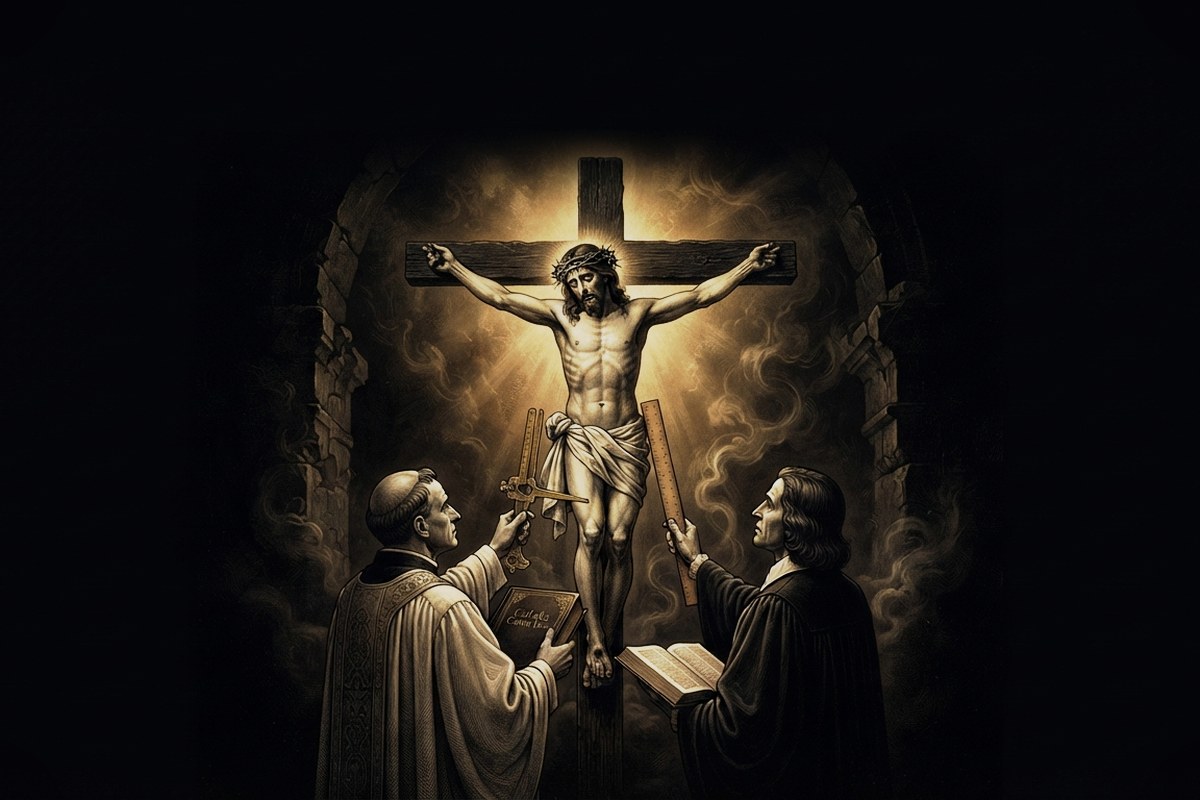
Same Jesus. Same cross. Same command not to judge. Both sides have spent five centuries measuring each other with a ruler built for something else, and calling the shortfall damnation. Put the ruler down and the argument ends, because there was never anything there to measure but your own reflection.
Want to decode passages like this without getting lost?
Get the free quick-start guide: 10 Core Bible Symbols Decoded in Plain English — plus a 2-minute way to use any symbol on a hard day.
Instant PDF, plus a short weekly note. Unsubscribe any time.✦ This is only the surface ✦
Every word of the Bible carries a hidden meaning — and there is far deeper teaching in the Parallels, the full study library.
Enter the Member Library Join on Telegram