John stood in the Jordan and people came down the bank by the hundred. They went under, they came up, they walked home wet. He was not selling a ceremony. He was doing something to their minds, and he knew it, because the very next thing out of his mouth was that his water was the smaller version of something still coming: "he who comes after me... he will baptize you with the Holy Spirit and fire" (Matthew 3:11).
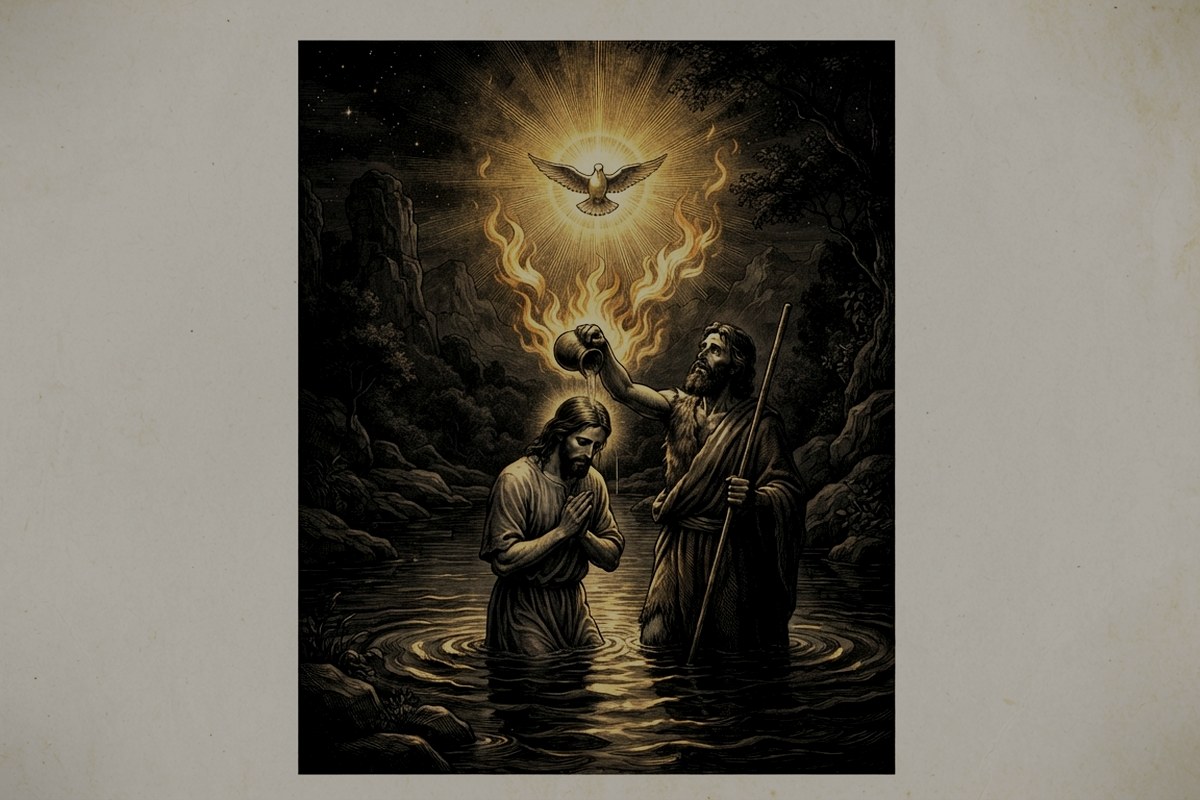
That one sentence should end every argument about sprinkling and dunking. If water baptism were the real thing, why would the man who made it famous announce that a greater one was on the way, and that it involved no water at all?
Water Is What You Feel In
Look at the first time water appears in the Bible. "The Spirit of God was hovering over the face of the waters" (Genesis 1:2). Nothing has been made yet. There is only deep, and something moving over it.
That is a picture of the inside of you before anything is decided. Water in scripture is the emotional side of the mind — the part with no fixed shape, that takes the shape of whatever you put in it, that rises and falls on a schedule you did not set. When the psalmist writes "deep calls to deep" (Psalm 42:7), he is not describing a lake. He is describing one level of feeling answering another, from underneath, without asking your permission.
This is why water is never neutral in the Bible. It blesses and it drowns with the same hand. A man at peace with his own feeling is standing on solid ground. A man afraid of his own feeling is already going under.
Going Under Is the Whole Point
The Greek word behind baptism means to dip, to plunge, to put completely under. Not a splash. Not a mark on the forehead. All the way down, so that what went down does not come up the same.
Paul says exactly that: "We were buried therefore with him by baptism into death, in order that, just as Christ was raised from the dead... we too might walk in newness of life" (Romans 6:4). Buried. That is a strange word to use about a bath, unless the bath is a funeral. Something in you has to stop breathing.
The something is the old self — the version of you built out of fear, out of what people said, out of every time you were told what you were. That self does not get improved by water. It gets drowned. And you cannot drown it while keeping one hand above the surface, which is exactly why the ritual is so comfortable: it lets you say you died without dying.
Peter found this out on the sea. He stepped out and walked, and then he noticed the wind: "he was afraid, and beginning to sink, he cried out, 'Lord, save me'" (Matthew 14:30). The water was not the problem. The fear was the water. The moment his attention went to the wind, the feeling rose in him and he went down in it. Jesus caught him by the hand — imagination reaching into a man's panic to hold him at the level he had forgotten he could stand on.
The Baptism With No River
John says the greater baptism is with spirit and fire. Spirit is breath, the invisible thing that makes a body alive. Fire is what burns off what is not you. No river needed. Both happen inside a mind that has stopped arguing long enough to see.
This is what Jesus means when he tells Nicodemus, "unless one is born of water and the Spirit, he cannot enter the kingdom of God" (John 3:5). Two births. The first gave you a body and a set of fears to go with it. The second is not a ceremony someone performs on you — it is a realization you arrive at. You see that the self you have been defending was never the real one, and the thing that sees it is what scripture keeps calling the Son.
Fire does not destroy the man. It destroys the chaff: the opinions, the rehearsed answers, the story you tell about yourself. What is left is the part that was always there and never needed defending. That is the resurrection, and it is not a comeback of the old self. It is a different person standing where the old one used to be.
So What Were You Dunked Into
You have been baptized already, many times, in things you did not choose. Into a family's fear. Into a town's idea of who succeeds. Into a job, a failure, a diagnosis, a way of talking about yourself you have repeated so long it feels like your face. Whatever you go under, you come up shaped by.
That is the only question the water really asks: what are you letting cover you? Paul answers it for the Colossians — "having been buried with him in baptism, in which you were also raised with him through faith" (Colossians 2:12). Raised. Past tense. Already done. Not a future event to wait for, a place to stand this morning.
The river is still there. It is the feeling you have been avoiding, and it has been trying to carry you the whole time.
Want to decode passages like this without getting lost?
Get the free quick-start guide: 10 Core Bible Symbols Decoded in Plain English — plus a 2-minute way to use any symbol on a hard day.
Instant PDF, plus a short weekly note. Unsubscribe any time.✦ This is only the surface ✦
Every word of the Bible carries a hidden meaning — and there is far deeper teaching in the Parallels, the full study library.
Enter the Member Library Join on Telegram