Every church I have ever walked past has a pool behind the altar, a basin by the door, or a river on its calendar. Baptism, we are told, is water. So the arguments begin: sprinkle or dunk, infant or adult, once or many times. Whole denominations have split over how much water and how much of a person it should touch.
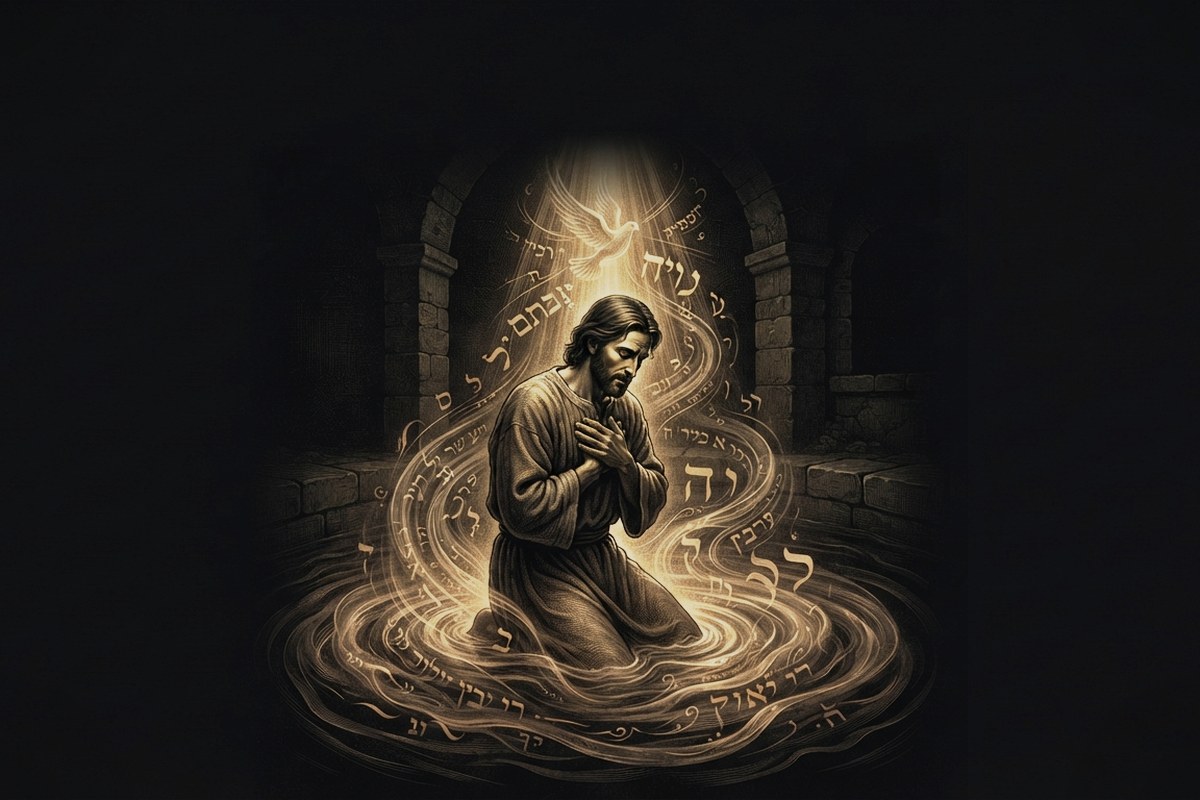
It is worth noticing what all of those arguments have in common. Every one of them assumes God is grading the water.
He is not. Water was never the point. Water is a symbol, and the symbol has one meaning all through scripture, from Genesis to Revelation. Once you see what it stands for, baptism stops being a ceremony you attend and becomes something that can happen to you anywhere, at any hour, with nothing in the room but you and what you are willing to understand.
Water Means Truth
Look at how water behaves in the Bible and the pattern writes itself. It washes. It cleanses. It satisfies thirst. It springs up from inside a person. It covers and drowns and gives life, depending on whether you are standing in it or trying to outrun it.
Now read that list again and substitute the word truth. Truth washes away confusion. Truth satisfies a thirst nothing else touches. Truth springs up from within you. And a mind drowning in a truth it has been avoiding goes under just as surely as a body in deep water.
The Bible says so outright. In Ephesians, the writer describes being cleansed by the washing of water with the word. Same sentence, both words, one meaning. In John, Jesus calls himself living water and says whoever drinks will never thirst again. He is not offering a beverage. He is offering understanding that ends the search.
So when John stands at the Jordan and immerses people in water, the picture is not a man administering a bath. It is a man immersing minds in truth, and telling them plainly that someone is coming who will do it with fire and spirit instead.
The Verses That Settle It
If baptism were water, the New Testament would be strangely careless about it.
John the Baptist says the one coming after him will baptize with the Holy Spirit and with fire, and points out that he himself only used water. Acts repeats it: John baptized with water, but you will be baptized with the Holy Spirit. Two baptisms, and the greater one involves no liquid at all.
Peter, writing about the flood, makes the point almost too directly. He says baptism now saves you, and then defines it in the negative: not the removal of dirt from the body, but the pledge of a good conscience toward God. He explicitly rules out physical washing. Whatever baptism is, it is not getting clean.
And the gospel of John lets slip something that should end the argument. Jesus did not baptize anyone. His disciples did. The one whose name is on the religion never personally administered the ritual everyone now insists is essential.
Then there is the thief on the cross. No water, no priest, no ceremony, no time. He is promised paradise the same day. If baptism were a water requirement, that promise is a clerical error.
What Immersion Actually Does
A word is being translated here, and the translation has cost us a great deal. The Greek word means to dip, to submerge, to be placed entirely under something.
Sit with that image. Not sprinkled. Not dabbed on your forehead by a man in a robe. Placed completely under.
Now imagine being placed completely under the truth until you stop coming up for air. Every opinion you held about yourself, about your worth, about what cannot possibly change, goes under that understanding and does not survive it. That drowning is the death of the old self, and what comes up is not the same person who went in.
That is why the language of the Bible is not washing but burial and rebirth. You are buried in water the way a seed is buried in soil. The old self goes down, the new self rises, and nothing about the transaction requires a body of water. It requires the truth you have been avoiding.
Nicodemus comes to Jesus at night and is told he must be born of water and of spirit. He immediately thinks of his mother's womb, and Jesus has to redirect him. He is talking about a birth inside you, in understanding and in spirit. No womb, no font, no river. A mind becoming new.
Why the Ritual Survived Anyway
Because a ceremony is easier than a change.
It is a small thing to be sprinkled and go home unaltered. You get the photograph, the certificate, the well-wishes. Nobody in the room can see whether anything actually happened inside you, and honestly, neither can you, because nothing did.
It is another thing entirely to let truth go over your head. That costs you your opinions. It costs you the comfortable version of people you have been carrying around. It may cost you the way you earn a living or the way you talk to your own family.
The ritual is popular because it delivers the feeling of the real thing with none of its consequences. It is a photograph of a meal.
What This Means For You
You may be baptized thirty times and never once immersed in anything. That is not a tragedy of the church, it is a tragedy of the individual, and it is fixable at no cost and with no ceremony.
Ask yourself what truth you already know and have not yet let cover you. The one about the marriage that is not working. The one about the work that has been quietly killing you for years. The one about who you actually are when no one is watching.
That is the water. It has been waiting in plain sight. When you let it close completely over your head and you stop fighting it, the baptism in the Bible finally happens, and it happens in you.
Want to decode passages like this without getting lost?
Get the free quick-start guide: 10 Core Bible Symbols Decoded in Plain English — plus a 2-minute way to use any symbol on a hard day.
Instant PDF, plus a short weekly note. Unsubscribe any time.✦ This is only the surface ✦
Every word of the Bible carries a hidden meaning — and there is far deeper teaching in the Parallels, the full study library.
Enter the Member Library Join on Telegram